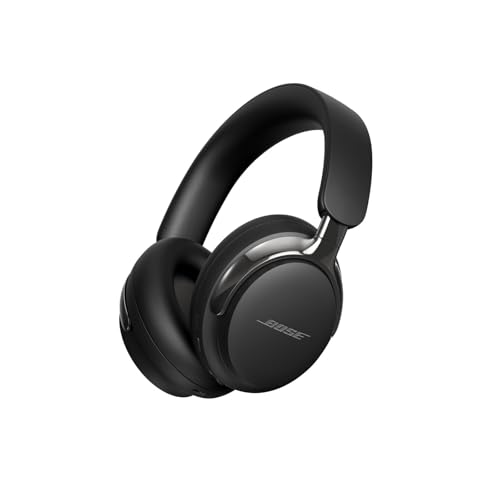
Bose has long been the name people think of when they want comfortable noise canceling headphones, and the QuietComfort Ultra Headphones (2nd Gen) are its premium over-ear model in our lineup. This profile goes through what Bose publishes about them: battery, Bluetooth, cables, listening modes, spatial audio and the CustomTune feature. We do not test products or take our own measurements. Everything here comes from Bose’s own product page, and where the page was silent on a point, we say so rather than fill the gap.
What Are the QuietComfort Ultra Headphones (2nd Gen)?
This is Bose’s second-generation QuietComfort Ultra over-ear headphone, which the product page labels as next-gen. It comes with a carry case and cables in the box, supports both wired and wireless listening, and sits at the premium end of this site’s ranking. Its closest competitor is the Sony WH-1000XM6, which makes a very different set of trade-offs. Bose’s page does not give a launch date, so we are not going to guess one. To see the current price, use the Amazon button below.
Noise Control and Listening Modes
Bose lists noise control as adjustable noise canceling, active noise canceling and echo reduction. There are four listening modes: Quiet, Aware, Immersion and Cinema. You can save up to 10 favorite modes and cycle through them from the headphones themselves, which is handy if you move between a loud train, a quiet office and an evening movie. Bose’s page does not publish a microphone count, so we cannot tell you how many microphones are used for noise canceling or calls. The page simply lists a built-in microphone.
The page does not give decibel figures for noise reduction either, which is normal for manufacturers. If you want to compare noise canceling strength directly, the honest answer is that no spec sheet will settle it. What a spec sheet can tell you is the feature set, and here Bose offers adjustable levels, an Aware mode for hearing your surroundings and a mode saved in favorites for quick switching.
Immersive Audio and CustomTune
Two features define this headphone. The first is Bose Immersive Audio, which the page describes as spatializing sound for both music and video. The second is CustomTune, which Bose says adapts the sound to the shape of the wearer’s ears. Cinema mode is listed as a newer feature aimed at video content.
Spatial audio is a matter of taste. Some listeners love the wider, more speaker-like feel; others turn it off after a day. The practical cost is battery, since Bose’s own battery figure drops when Immersive Audio is on (see below). Our suggestion is to treat it as a feature you switch on for movies and some music and leave off when you want maximum endurance.
Battery Life and Charging
According to Bose, the headphones offer up to 30 hours of battery life, or 23 hours with Immersive Audio on. A footnote on the page lists lower figures from Bose’s own test conditions: up to 24 hours with Immersive Audio off and up to 18 hours with it on. That makes the 30-hour figure a best case, so budget for something lower if you listen at high volume or with spatial audio all day.
Charging is quick: the comparison table lists 15 minutes of charging for 3 hours of playback, and the spec table lists a full charge time of 3 hours. The page does not give separate figures for noise canceling on and off, so we do not quote any.
Bluetooth and Wired Connections
Bose lists Bluetooth version 5.4 with a range of 30 feet, using the A2DP, HFP, AVRCP and Bluetooth Low Energy profiles. The spec table does not name the standard codecs such as AAC or SBC. The page does mention Snapdragon Sound’s aptX Adaptive codec in connection with a low-latency gaming mode, which means phones with that technology can take advantage of it. If codec support is crucial for you, check your phone’s specifications first.
The box contents are generous. Bose lists a 3.5 mm to 2.5 mm audio cable and a 39-inch USB-C to USB-C cable. Bose describes wired USB-C audio as lossless and lists USB audio support at 16-bit, 44.1 kHz or 48 kHz. That is a very practical combination if you want to plug into a laptop or a USB-C phone without any wireless compression, and the analog cable covers older devices and airplane seatback screens, provided the plug type fits.
The page we read does not mention multipoint, the ability to stay connected to two devices at once. That does not prove it is missing, but it also means we cannot promise it. If switching between a laptop and phone is a daily need, confirm it with Bose before buying. The Bose QuietComfort Headphones (2nd Gen) are the model in our list where Bose does state two-device connection.
Design, Weight and Case
Bose lists 0.583 lb for the headphones alone, about 9.3 oz. The much larger 1.061 lb number on the same page covers the whole product system including packaging, so do not read it as the headphone weight. A carry case is included. The page describes an adjustable headband and does not say whether the earcups fold, so we cannot tell you whether this model packs smaller than a flat-folding rival. For a comparison with a foldable rival, see the Sony profile linked above.
The Bose App
The Bose app is available on Google Play and the Apple App Store. It handles step-by-step setup, customizable EQ and shortcuts, and it is where you manage modes and updates. Bose says the headphones also work over Bluetooth without the app, but you need it for the full feature set. If you hate installing manufacturer apps, you can still use the basics, but you would miss CustomTune, modes and updates.
Who Should Buy These Headphones
- People who want a full-featured premium headphone with a carry case, a USB-C cable and an analog cable already in the box.
- Movie and series fans who will use Cinema mode and Immersive Audio.
- Anyone who likes to tweak sound. EQ, CustomTune and 10 favorite modes reward people who enjoy a bit of tuning.
- Laptop and USB-C phone users who want a wired digital connection as a backup.
Who Should Look Elsewhere
- Anyone who needs confirmed multipoint. Bose’s page did not mention it.
- Shoppers who need a confirmed folding design. The page does not describe folding.
- iPhone users who want Apple’s own ecosystem features. The Apple AirPods Max 2 are made by Apple for that purpose.
- Budget buyers. This is premium-tier. Mid-range alternatives sit lower in our ranking.
What to Check on the Amazon Listing
- Generation. The title should say 2nd Gen. Older Bose listings can look similar.
- Color. Bose’s page names the Cherry Chocolate color and shows others without naming them. Make sure the color in the photo matches the one you want.
- Seller and warranty. Check that Bose or an authorized seller ships the headphones, so the warranty applies.
- Box contents. Confirm the case and both cables are listed in the product details.
- Customer reviews. Look at what recent customers say about fit, comfort for long sessions and glasses.
Bottom Line
The Bose QuietComfort Ultra Headphones (2nd Gen) are a feature-rich premium headphone: four listening modes, Immersive Audio, CustomTune, Bluetooth 5.4, lossless USB-C and a generous box. The compromises are the battery life that falls to 23 hours with spatial audio, the missing information on folding and multipoint, and the 16-bit USB audio limit. For people who value comfort-focused tuning and spatial sound, it is a very strong rival to the Sony.
See price on Amazon
For the full ranking, see our best headphones of 2026 comparison. If you would like a lower-tier Bose, read the Bose QuietComfort Headphones (2nd Gen) profile.
Sources